What Is AI Search SEO & How AI Overview Affect SEO?

If you have noticed your traffic numbers looking a little off this year, you are not imagining it. AI search SEO 2026 is a different game than what most marketers trained on even two years back. Google now answers a huge chunk of queries before a user ever scrolls to a blue link, and that one shift is rewriting how content gets planned, written, and measured. This guide breaks down what actually changed and what to do about it.

The Shift In AI Search SEO 2026 Nobody Can Ignore Anymore!

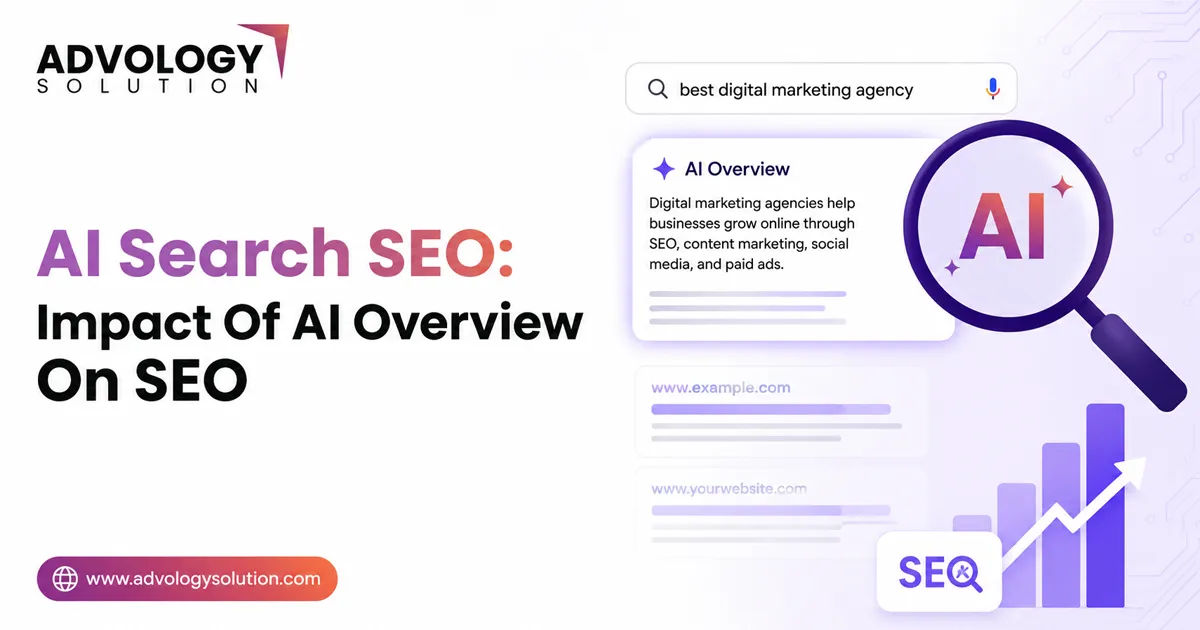
Search results don't look like search results anymore, not really. Type almost any question into Google today and there's a good chance an AI-generated summary shows up before a single organic listing does. This is Google AI Overviews SEO, and it now touches close to half of all tracked queries, up sharply from where it sat just a year ago.

  • For informational and "how to" style searches, that number climbs even higher, some studies put it near 99% for certain question formats.
  • What this means in practical terms is SEO zero-click search 2026 behavior. Roughly two out of every three Google searches now end without a click to any website at all, and on mobile that figure runs even higher than desktop.
  • When an AI Overview is present specifically, that zero click rate jumps to somewhere around 80 to 83%. Users get their answer right there on the results page and move on with their day. For a business that built its whole content strategy around organic sessions, this is not a small dip, it's a structural change in how value gets delivered.
  • The organic CTR drop 2026 data backs this up from every angle. Position one used to pull in roughly 30% of clicks on a good query. With an AI Overview sitting above it, that same position now gets closer to 19-20%, a drop of nearly 38% relative to before.
  • That is the AI Overview CTR impact in a summarised manner, and some studies measure the decline even steeper depending on industry and query intent.
  • Health, tech support, and recipe content have been hit hardest because AI can summarize those answers with high confidence.
  • Transactional and e-commerce queries, on the other hand, barely trigger an AI Overview at all, so shopping-related SEO is holding up far better than most people expect.
Metric 2026 Figure
Overall Google zero-click rate ~65%
Zero-click rate when an AI Overview appears 80% - 83%
Zero-click rate inside Google AI Mode ~93%
Position 1 CTR, no AI Overview present ~30%
Position 1 CTR, AI Overview present ~19% - 20%
Users who click a citation link inside an AI Overview ~1%
Extra organic clicks earned by brands cited in an AI Overview +35%
E-commerce queries that trigger an AI Overview ~3% - 4%

None of this means SEO is finished. It means the target moved. Instead of chasing a click, the new job is earning a mention inside the answer itself, even when that mention doesn't send a visitor your way.

SEO vs AEO vs GEO: What's Actually Different?

People throw these three terms around like they mean the same thing, they don't. Understanding SEO vs AEO vs GEO is honestly the first step to building a strategy that works this year instead of one built for 2022.

Traditional SEO is still about ranking a page in the ten blue links, built on backlinks, on-page optimization, and technical health. That part hasn't gone away, Google still needs to have that crawl, index, and rank your pages, and those rankings still feed the AI systems above them.

AEO answer engine optimization is about structuring content so it directly answers a specific question in a clean, extractable format. Think concise definitions, numbered steps, and a clear answer within the first couple sentences of a section. AEO isn't chasing a ranking position, it's chasing the spot inside a snippet or an AI-generated box.

GEO generative engine optimization goes a layer further. It's the practice of shaping your content so large language models like Gemini, ChatGPT, and Perplexity actually pull from it and cite it when generating a full answer. GEO cares less about your position on a SERP and more about whether an AI system trusts your page enough to quote it or summarize from it.

The three work together in 2026, not against each other.

  • Good SEO gets you crawled and indexed.
  • Good AEO gets your content into snippets and Overview boxes.
  • Good GEO gets you cited across ChatGPT, Perplexity, and Gemini conversations where there's no traditional SERP at all.

The table below lays out the differences side by side, which makes it easier to plan content around all three at once instead of picking just one.

Factor SEO AEO GEO
Main goal Rank in the ten blue links Win the snippet or answer box Get cited inside AI-generated answers
Optimized for Google's classic ranking algorithm Direct, extractable answers LLMs like ChatGPT, Gemini, Perplexity
Success metric Rankings and organic clicks Snippet and Overview appearances Citation frequency and brand mentions
Key tactic Backlinks, technical health, keywords Concise Q&A structure, clear headers Original data, freshness, authority

What Google's February 2026 Core Update Actually Changed?

Google confirmed a broad core update on February 1, 2026, and it landed right in the middle of the AI search shift, which is not really a coincidence. The update sharpened Google's ability to tell the difference between low-effort AI-generated filler and genuinely useful content, no matter how that content was produced.

E-E-A-T signals 2026 moved from a nice-to-have to something close to a requirement. Pages that clearly name their authors, show real credentials, and demonstrate hands-on experience with the topic outperformed anonymous or thin content by a wide margin. Google also quietly added a new "Authors" section to its Search Central documentation around the same time, reinforcing that byline transparency now matters at an algorithmic level, not just a trust level. Around 43% of sites are still failing basic Core Web Vitals thresholds going into this update too, so a lot of the ranking losses weren't purely about content, page speed played its part as well.

Topical authority SEO was another clear winner. Sites publishing a tight cluster of interlinked, deeply researched content on one subject consistently beat generalist sites that cover everything a little and nothing well. If your site jumps between dozens of unrelated topics, that update likely hurts you more than you realize.

Originality also got weighted heavier. Pages built from rehashed competitor research, without a genuine data point, quote, or first-hand insight, saw the sharpest declines. AI tools aren't the villain here, Google has said as much directly, it's content published purely to farm search traffic at scale that gets punished.

How To Rank In AI Answers, ChatGPT, And Perplexity?

This is the part most people actually came here for, so let's get practical. Figuring out how to rank in AI answers isn't a mystery, it just requires a slightly different checklist then classic SEO.

  • Start with structure. Answer the core question in the first two or three sentences of any section, then expand with detail afterward. AI systems and Google's summarization engine both favor content that front-loads the answer instead of building up to it through a long intro.
  • Build a ChatGPT SEO strategy around being the kind of source ChatGPT's browsing and training data would want to pull from: clear, well-organized, factually dense pages with dates and specifics rather than vague generalities. ChatGPT and other assistants tend to favor pages with strong topical depth, recent publish dates, and a track record of being cited elsewhere.
  • Perplexity SEO optimization leans even more on citations and freshness since Perplexity is built as a live, source-linking answer engine. Getting cited there often comes down to having original data, a clearly labeled publish or update date, and content that reads as a primary source rather than a summary of somebody else's summary.

Here's a quick side-by-side of what each platform actually rewards, based on patterns seen across 2026 citation studies:

Platform What It Rewards Most? Best Content Format
Google AI Overviews Topical authority, schema markup, strong page experience Direct answer up top, backed by FAQ schema
ChatGPT Structured, dated, factually dense pages Clear headers, organized long-form detail
Perplexity Freshness, original data, source-linkable claims Primary-source style with visible timestamps

A few things that consistently help across all three platforms:

  • Publishing original research, surveys, or first party data whenever you can, even something small.
  • Keeping factual claims specific and verifiable, never vague or exaggerated.
  • Updating older content regularly instead of letting it go stale.
  • Use clear headers that mirror how people actually phrase questions.
  • Link internally to related pages so AI crawlers understand the fuller topic cluster.

Structured Data, Schema, And Content Built For AI Crawlers

If there's one technical fix that keeps showing up across every 2026 study, it's this: structured data schema genuinely works, and most sites still don't use it properly.

  • Google has confirmed schema markup helps its systems understand page content faster and more accurately, and case studies back it up.
  • Rotten Tomatoes reportedly saw a 25% CTR bump after adding richer markup, and Food Network reported a 35% jump in visits, so the gains aren't just theory anymore.
  • Writing content for AI crawlers means thinking about machine readability alongside human readability. That means clean heading hierarchy, tables where comparisons make sense, bullet points for lists instead of dense paragraphs, and schema markup on FAQs, articles, and products.
  • AI systems, including Google's own AI Overview generation, lean heavily on structured signals to decide what's trustworthy enough to summarize or quote.
  • Page experience matters here too, more than people expect. A meaningful share of sites still fail Google's Core Web Vitals thresholds, and slow, clunky pages correlate directly with ranking losses during core updates.
  • Google's current 2026 targets sit at an LCP under 2.5 seconds, an INP under 200 milliseconds, and a CLS under 0.1, and pages missing those marks by a wide margin lost noticeably more traffic after recent updates.
  • If your content is great but your page takes five seconds to load, you're making it harder for both users and crawlers to reward you.

Featured Snippets, Voice Search, And Question-Based Content

A featured snippets strategy is more valuable now than it's ever been, mostly because a snippet-optimized page is already halfway built for an AI Overview citation too.

Both formats reward the same habits: a direct answer near the top, a clear question-style heading, and a format (list, table, short paragraph) that matches how the question was asked.

This ties straight into question-based content. Long, conversational searches (eight words or more) trigger AI Overviews far more often than short keyword searches, so structuring articles around real questions people type or say out loud pays off twice, once for snippets and once for AI citations.

  • Voice search optimization follows the exact same logic since most voice queries are spoken as full questions. "What's the best way to remove a coffee stain" performs better in voice results when your page literally has a heading close to that phrasing, followed by a short, direct answer.
  • Conversational search behavior overall has shifted how people phrase queries, less "dentist Bikaner" and more "which dentist near me handles same day emergencies". Content that mirrors natural phrasing, rather than stiff keyword strings, tends to match this pattern more naturally and gets picked up more often by AI systems trying to match intent.

Multi-Modal Search And What's Coming Next!

Multi-modal search trends are worth watching closely this year. Google's search experience increasingly blends text, images, and video into a single results experience, and tools like Google Lens and AI Mode are pulling in visual search at a scale we haven't seen before.

Optimizing image alt text, video transcripts, and captions isn't optional anymore, it's part of the same visibility strategy as your written content.

AI Mode itself deserves a mention. It's now available broadly and works differently from a standard AI Overview, it runs multiple parallel searches (Google's own "query fan-out" system triggers around 16 related searches per question) behind a single question and stitches the results into one conversational answer with citations at the bottom.

Getting cited inside AI Mode responses will likely become as important as ranking on page one used to be.

Measuring What Actually Matters Now

Old-school SEO reporting leaned almost entirely on sessions and click volume. That single metric doesn't tell the full story anymore.

  • AI-referred traffic, meaning visits coming from ChatGPT, Perplexity, Gemini, and other AI tools, is small in raw numbers today but growing fast, some platforms report referral traffic from AI tools growing by over 500% year over year, and it tends to convert at a noticeably higher rate than average organic traffic because these are already high-intent visitors.
  • Getting cited by AI engines should be tracked as its own metric alongside rankings and clicks. Run your target queries manually through Google's AI Overview, ChatGPT, and Perplexity every month or so and note whether your brand shows up and how it's described.
  • That single habit tells you more about your real AI search visibility than a rankings report ever will on its own. Brands that do get a citation inside an AI Overview see around 35% more organic clicks on that same query compared to brands that don't, so the payoff for showing up is measurable even in a zero-click world.
  • The brands treating LLM citation strategy as a core part of their SEO program, not an afterthought, are the ones showing up consistently across AI Overviews, AI Mode, and third-party chat tools.

That's where the next few years of search visibility are actually headed, and it starts with the content decisions being made right now.

AI search isn't just another passing trend, it's the new normal. Rankings still matter a lot, but being cited, quoted, and trusted by AI systems matters just as much now. The SGE SEO impact we've all been tracking since Google's early Search Generative Experience tests has fully arrived, and the sites adapting their structure, authorship, and data now are the ones still getting found in 2027 and beyond. Waiting it out isn't really a strategy anymore.

So if you consider yourself ready to move with this new shift, the team at Advology Solution can get that done for you from absolute basics to the advanced level.